


A new era for civics education in Idaho

Idaho took a significant step this year toward strengthening civics education and preparing the next generation for informed citizenship. Through a series of legislative efforts, lawmakers have placed renewed emphasis on ensuring students understand American government and appreciate the principles of liberty and justice that this country was built on.
At the center of these changes is Senate Bill 1336, a sweeping update to civics and history instruction across the state. The law reinforces the simple but powerful idea that a strong republic depends on citizens who understand its foundations.
Under this legislation, Idaho’s eighth-grade students will be required to have a full year of instruction in Western Civilization. High school students will be required to complete two credits in American history and two in government, during which they will review foundational documents such as the Declaration of Independence, the U.S. Constitution, and the Federalist Papers.
Instruction will also emphasize the principles behind them like natural rights, the rule of law, separation of powers, and the responsibilities of citizenship. In addition, students will study the history and consequences of totalitarian ideologies like communism and fascism, helping them better understand how these systems contrast with America’s constitutional framework.
But policy alone doesn’t tell the full story. What makes Idaho’s approach unique is its focus not just on knowledge, but on character and engagement. SB 1336 explicitly calls for teaching the “cardinal virtues” necessary for self-government, including prudence, justice, fortitude, moderation, and patriotism.
This focus on civics education is complemented by another major initiative: the creation of a Civics Seal through House Bill 712.
This joint effort by the Superintendent of Public Instruction, Debbie Critchfield, and members of the legislature was enacted to elevate civic participation to the same level of recognition as athletics, music, or academic honors.
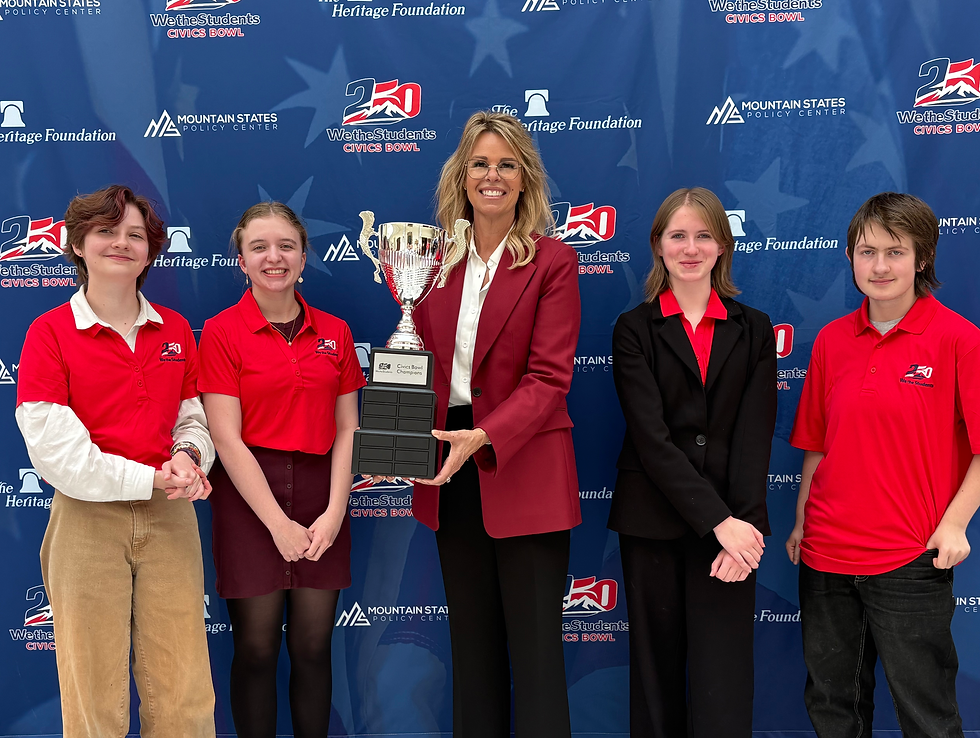
From student councils and mayoral youth advisory boards to participation in events like Mountain States Policy Center’s recent “We the Students” Civics Bowl (congrats again to Xavier Charter School for winning), many young people across the state are deeply engaged in their communities, yet their efforts have often gone unrecognized.
The Civics Seal changes that.
Under the new law, graduating seniors who meet a set of rigorous criteria, going beyond standard coursework, can earn a civics literacy seal on their diploma. These students may also wear cords at graduation, publicly recognizing their achievement. The requirements include not just academic proficiency, but also meaningful civic engagement, such as community involvement and applied learning projects.
There’s also a broader vision at play. Schools where 75% of students earn the Civics Seal may receive a designation as a “School of Civics Literacy,” creating an incentive for entire communities to prioritize civic education.
Alongside these changes, Idaho is also raising the bar for how civics knowledge is assessed. A revised civics exam is set to take effect in the 2027–2028 school year and will replace a simpler, previous format with a more rigorous evaluation of student understanding. The updated test will cover key concepts such as the Electoral College, the separation of powers, and the Idaho Constitution, ensuring students graduate with a deeper and more practical understanding of how government works.
Importantly, Idaho’s approach to education maintains a balance between state standards and local control. The state defines what students should learn, while local school districts determine how that learning takes place. This allows communities to tailor instruction while still meeting high statewide expectations.
That local input has already made a difference.
During the process of updating civics standards, community members identified an important gap: the story of Rebecca Brown Mitchell, a key figure in Idaho’s history of women’s suffrage. After advocacy from parents and educators, her contributions were added to Idaho’s Social Studies Content Standards.
Mitchell’s story is a powerful example of civic engagement in action. After moving to Idaho as a young widow, she became a leading voice in the fight for women’s right to vote and helped Idaho become one of the first states to grant that right. She later made history again as the first woman to deliver an opening prayer before a legislative session.
Her legacy underscores the very lesson Idaho’s new civics efforts aim to teach: that individuals, informed and engaged, can shape the course of history.
Taken together, these initiatives represent more than a set of policy changes. They reflect a broader commitment to preparing students not just for graduation, but for citizenship by cultivating a generation that understands its history, values its freedoms, and is ready to take an active role in preserving both.


