


Washington legislation would target parked cars to pay for light rail cost overruns

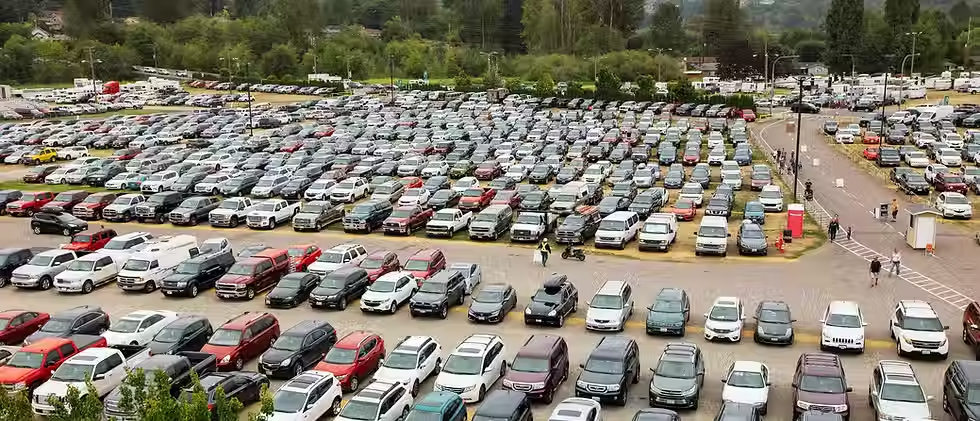
A new bill in Washington state would target parked vehicles for expired registration. Senate Bill 6172 could be voted on by the Senate soon. The measure received backlash from local radio and online news publications, as many feel it is another push to punish drivers for an unfair valuation system that sends driver fees to transit while roads and bridges crumble from a lack of maintenance and preservation.
Anecdotally, it appears some people are refusing to renew their car registration out of protest to Sound Transit’s high car tab fees. According to CARFAX, there are approximately 600,000 vehicles in Washington state that have expired registrations, presumably some of which would normally be renewed without the protest or if renewals were less of a financial burden.
Sound Transit
The biggest benefactor of the bill would likely be Sound Transit, the regional transit agency tasked with building rail in King, Pierce, and Snohomish Counties. Sound Transit relies heavily on driver registration fees, called the Motor Vehicle Excise Tax, to pay for its transit infrastructure. And that agency is in trouble, again.
In fact, it has been since its inception in 1996, with the rail agency falling far behind voter-approved plans for light rail service between Tacoma and Everett and the surrounding areas. Cost estimates ballooned and plans were reduced on the original line, on the second phase, and, just recently, Sound Transit officials said cost overruns on the ST3 program are expected to exceed $35 billion. As a result, taxpayers are forced to shoulder the burden of broken promises and underwhelming results.
Another bill was introduced during the session to allow Sound Transit to borrow money for past the typical 30-year debt to an astonishing 75-year bond period. This bill was adopted by the Senate 29-20 on February 11, despite Sound Transit already having borrowing tools that allow them to issue debt. For example, Sound Transit may increase its debt cap with a simple 60% vote of the district, but it’s likely that public officials hardly have that much support to issue more debt, so they opt instead to push the debt across three generations of Washingtonians.
27-year fight for car tab relief
In 1996, lawmakers introduced an unfair way to pay for Sound Transit by taxing vehicles based on the Manufacturer Suggested Retail Price and an inflated depreciation schedule. Soon after taxpayers began receiving their registration renewals, Initiative 695 passed at the ballot box to reduce car tab fees to $30. With fees rising again, voters passed Initiative 776, to reduce car tab fees again, but since Sound Transit had pledged the revenue source to borrow money, the State Supreme Court said it could continue charging unfairly until the bonds were paid off.
With the passage of ST3, Sound Transit officials again used the old, unfair value system, even though the legislature had passed a new, fairer schedule. Sound Transit officials said at the time that they could have used the fairer system, but opted for the unfair system instead because it’s easier. The Seattle Times explained in 2017:
“Patrick said that ST3’s tax increases could have been applied to the more modest valuation chart — which would have meant less revenue for the agency — but, for simplicity’s sake, were not.”
That’s why in 2019 voters passed I-976 to limit car tab fees again to $30, but the State Supreme Court struck it down again based on the grounds that voters could have been misled by the initiative.
Despite the voters limiting car tab fees, Sound Transit and state officials have continued to impose fees above the voter-supported $30 limit.
SB 6172 would allow police to ticket parked cars with expired tabs
Senate Bill 6172 would change the way police enforce expired registration by allowing non-moving vehicles in a public right of way to be cited for expired registration (parked cars), as opposed to the requirement that vehicles must be in operation to be cited under current law.
Fines imposed for expired registrations for parked cars are $150 if the tabs haven’t been renewed within two months, and $242 if it has been expired for more than two months.
Support & Opposition
Supporters of the bill claim that it is a civic duty to pay taxes that the government imposes, even with the understanding of voters’ concerns about high car tab fees. They argue that transportation and transit projects need funding and a reduction in government revenue puts projects at risk.
Opponents of the bill cite strong voter sentiment against high car tab fees and unfair valuations, referencing the popularity of past measures struck down by the court.
Conclusion
Public officials know the sensitivity surrounding exorbitant car registration fees and Sound Transit woes. They even acknowledge the ridiculously high costs of car tab renewals, with bills to put people on payment plans to simply renew their car tabs. Just increasing enforcement of those registration fees without lowering the cost or providing accountability only enables out-of-control spending and taxation, and will do little to increase public trust in an agency and a system that continually disappoints the state’s seven million registered drivers.
The phrase “render unto Caesar” comes into play here, but lawmakers should understand that they are to represent the people of Washington state, who have said time and time again that car tabs are just too damn high.


